
Friday, November 11, 2011
Wednesday, November 9, 2011

Monday, November 7, 2011
Boycotting the Ballot Box

As the opposition party (CDC) here in Liberia continues to hurl allegations at the National Election Commission (NEC) around the issues of fraud, Liberian’s are growing weary of all the mud slinging and talk of boycotting. Especially, because the CDC, have repeatedly been unable to support these allegations with substantial evidence. Last week, a second attempt to hold presidential and vice-presidential debates failed once again when the opposition refused to attend. Earlier last week, Winston Tubman, the standard bearer for the CDC was requested by ECOWAS to attend a meeting in Nigeria with Nigerian President Goodluck Jonathan. Rumblings are that he agreed at the talks to call off the boycott, but no sooner had his plane tires hit the tarmac in Monrovia than he had re-pledge his support of the boycott and urged CDC supporters for follow suit.
Unfortunately, today on the eve of the run-off election a gathering at CDC headquarters this afternoon took a violent direction. Police used teargas and fired live rounds into the crowed leaving many people injured and several others dead. This tragic turn of events will surely impact the confidence Liberians have about going to the ballot boxes tomorrow, and it is sad for me to think the country will not wake on Oct 8, 2011 with the same level of enthusiasm and dedication for the democratic process as they did on October 11, 2011. One can only hope that as Liberians lay down to rest tonight they have one thing on their minds and that is peace, above all else.

Monday, October 24, 2011
Cultural Input
I have been posting a lot recently about the elections and more formal systems of governance and political activism, here is another perspective on political activism that can be found in Liberia.
Wednesday, October 19, 2011
Liberians not yet done with Democratic Duty: Preliminary Results Yield Run-off

According to the preliminary results released by NEC (National Election Commission), Liberians will be heading to the polls once again on November 8, 2011 to determine who will lead the country for the next five years.
Many Liberians are not surprised by the announcement that this first round of elections has resulted in a run-off; with 16 presidential candidates and the need to win 50% plus one vote it seemed unlikely from the start that any candidate would achieve this number during the initial race.

For some Liberians there is a sense of déjà vu, with the 2005 elections also resulted in a run-off with then presidential candidate George Weah of the CDC (Congress for Democratic Change) leading the first round and Ellen Johnson Sirleaf of the UP (Unity Party) coming in at a close second. However, in 2005 in the second round Ellen Johnson Sirleaf and the UP were able to make significant gains during the two weeks of campaigning prior to the run-off and she came back to top George Weah in the final race.
For the 2011 election, incumbent Ellen Johnson Sirleaf has been up against a new CDC presidential candidate Winston A.Tubman and she has lead the first round with 44% of the vote. If anything has been learned from the 2005 process, it’s that going into the second round of campaigning, scheduled to start on October 26th it is really any candidates’ game.
The important thing for all political parties and candidates to remember during the run-off is that regardless of how eager they are to secure the position of head of state, they must put the country and Liberians first and continue to engage in peaceful, respectful and fare campaigning. The ECC (Election Coordinating Committee) will continue to monitor the electoral process and encourage all stakeholders to respect the outcomes of the elections and the will of the Liberian people. Today they issued a press release that stated:
During this critical period of the electoral process, the ECC urges all political parties and candidates to maintain the peace, and wait for NEC to release the final results. Any grievances thereafter should be addressed according to law and through the NEC as the initial course of redress. In the interim, they should refrain from making public statements that could incite violence and undermine the credibility of the elections that have been effectively administered thus far.

Like in any country during a time of heated political campaigning, candidates and political party supporter will likely have the strong temptation to engage in some political mud slinging. Nevertheless, it is important to remember that in a country still working to build civil societies confidence in the democratic process, they must take real caution to heed the advice of the ECC and refrain from engaging in any activities that may “undermine the entire electoral process and the gains made thus far in strengthening democracy and maintaining peace and stability in Liberia”.
Thursday, October 13, 2011
Dedication to Democracy – Liberians Take to the Polls

Search for Common Ground has published my article about my experience as an ECC election observer here.
2011 Liberian Election Results

Wednesday, October 12, 2011
Dedication to Democracy

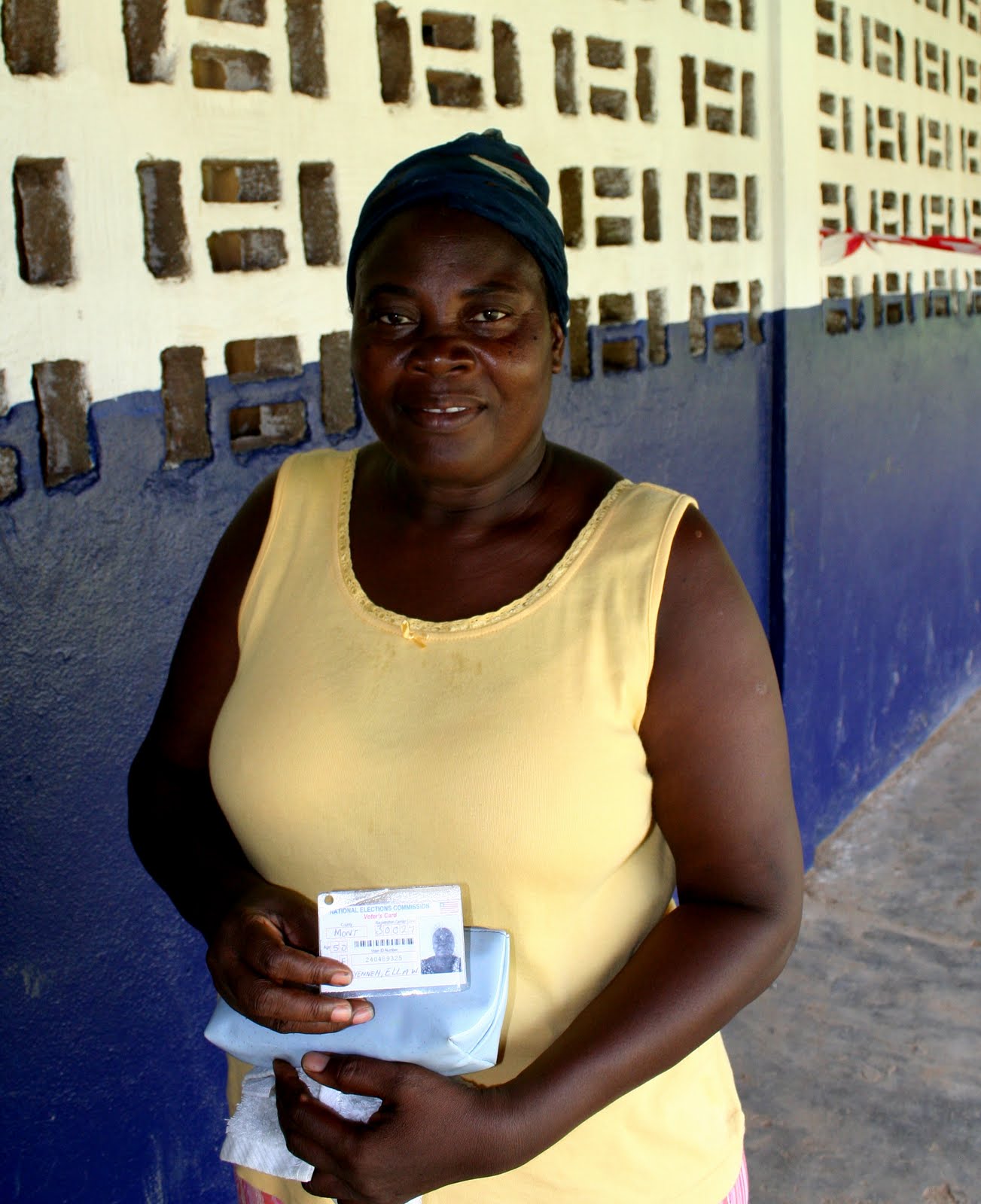
A woman outside of a polling station shows me her voting registration card
What I witnessed yesterday here in Liberia can only be recorded in history as nothing short of true dedication to the democratic process. The morning sky was covered with large grey rain clouds, but the mood in Monrovia was bright; people where enthusiastically queuing up outside of polling stations hours before they were scheduled to open at 8:00am in anticipation. I got to the Ushahidi office at 7:30am where the ECC (Election Coordinating Committee) data collection staff had started to arrive. The ECC had trained 20 observers on a data collection program that was designed to take calls about any critical incidences witness by the 2000 ECC monitors in the field.

A woman shows me her inked finger after she has cast her ballot
We arrived at the first polling station just as the rain started to become heavy, though the weather did not damper the spirit of the Liberian people. We were greeted with big smiles and people flashing us their voter registration cards. Inside, the polling staff was hard at work ensuring that each voter could easily follow the steps and successfully cast their ballot. Accommodations were made to ensure that people with disabilities, the elderly, pregnant women and women with small children could easily vote without having to wait in the long queues. I witnessed a 82 year old blind woman, assisted by a family member she trusted casting her vote, she smiled as she came out from behind the polling box proud to be doing her civic duty.

Women with small children were escorted to the front of the line to cast their votes
We reconvened at the Ushahidi office around noon to see if our experience of calm, peaceful and professional polling centres different in other areas of the country. The ECC data entry staff were happy to report that the phone lines had remained quiet all morning, except for the reports they had received from the field, which confirmed that the mood we had experienced here in Monrovia was being echoed across the nation.

A polling attendant checks the final voter registration before issuing the man his ballots
As the heavy rain lifted, we continued roaming around the city, stopping in at various polling stations to ensure that the process was still running smoothly. Each polling place we visited the rooms were filled with political party observers, security personal, polling staff, international observers and a monitor from the ECC. While the long day continued, people started to look tired, but their patience and dedication to overseeing the process did not waiver. As the light started to fade and the last few ballots were cast, a quiet calm came over the city, except at the polling stations, which remained hives of activity. Each polling station was responsible for verifying the number of ballots that had been cast for the presidential, senatorial and representative candidates. The process was slow and tedious, as all observers present needed to verify each marked ballot, but everyone was respectful and persistent that the process be carried out in a very careful and proficient manner. Long after I had retired for the evening, dedicated Liberians all across the country worked up until 6:00am this morning checking and rechecking each precious vote.

All parties worked late into the evening verifying and reconciling the votes
The preliminary results will not be announce by the NEC until Thursday however, my feeling is that regardless of who is elected, Liberians everywhere should know that as a country they have won something greater than the candidates that will represent them for the next five years. They have all won the right to feel proud that they live in a country where every citizen has the right to participate in an electoral process that is free, transparent and peaceful.
Saturday, October 8, 2011
A Peaceful but Strong Reminder
Yesterday was an extremely important and historic day for Liberia, specifically for Liberian women. Not only did two Liberian women win the Nobel Peace Prize but it is particularly significant in a context where women (and not just the two women who were award this prize) are continuing to fight day in and day out to ensure that the small gains that have been made, here in Liberia are not lost to conflict. They continue to fight so that there daughters and sons can look forward to a future where they have access to education, good health care and free and equal participation in all aspects of society, including politics.
If you are interested in learning more about the contributions of President Ellen Johnson Sirleaf and Leymah Gbowee, please click to see their profiles that my current roommate, Tamasin Ford wrote yesterday in Monrovia, after the announcement of their win.
In addition the Guardian did a great Editorial: Nobel peace prize: arms and the woman
I hope yesterday can serve as a reminder to women and men all over the world, that we cannot cultivate free, peaceful and healthy societies without the equal and active participation of women and men in all aspects of life.
Liberia’s Healthy Appetite for Political Debate
Search for Common Ground has asked me to contribute to their blog and share my insights and observations as an intern here in Liberia. Please click here, to view my first blog post regarding the upcoming elections this Tuesday October 11, 2011.
Friday, October 7, 2011


Educate the Girl Child…Now Da should be Everyone’s Area!
On my way to work this morning I heard an interesting campaign on the radio about the importance of education for Liberian youth, more specifically the add seems to be for parents, aimed at promoting the education of their girl children.
When I get to the office I ask one of my colleagues, “If education is now *free for all children, both girls and boys, why is there still such an issue with parents choosing not to send their girls to school?”
One things that is really amazing about how Liberians answer questions, is that they do it in such a lyrical and narrative way. My co-worker is very well educated, articulate and extremely motivated to make political and social reforms in his country in order to ensure girls and women have equal access to education. He gives me a little smile that makes me know… I have much to learn before I understand the more subtle workings of Liberian society.
“Eh Lindsay...you know, sending the girl child to school is not easy O”, he says.
He goes on to tell me the story about how when he was growing up, his sister also did not go to school, even though him and his brother did. When I ask if it was a mater of financial constraints, he tells me no. The reason he gives is because of the rural location of their village, him and his brother had to walk several kilometers to and from school. Once they got to the high school level, they had to walk an even long distance to catch a ride from the elementary school into the high school that was located in the next town. He tells me how during rainy season because of all the mud on the path to school he used to have to take all his school clothes off put them in a plastic bag and walk to school in his underwear, and how for a boy child there is no shame in doing this, but for a girl child she could not possible do the same. He explains, how he would have to run very quickly to try and make it to the school in time to catch the ride and how there is no way his sister could have run as fast. He also tells me that when money was especially tight, and his family could not afford to replace his school uniform, he would ware it with rips, but how the family would have been too ashamed to send their girl child out with torn or dirty clothing.
I am grateful for my colleague sharing with me his own personal experience because it has shed some light on a few things for me. One major gender issue, is that family dignity and pride is still so intricately linked to the protection and “decency” of their girls. I think this is still true in many countries and cultures throughout the world. Secondly, there is still this belief that biologically, women are somehow inferior to men and that due to our weaker state we cannot possibly endure the same kind of physical challenging activities that men undergo. I find this channel of argumentation particularly annoying, because I feel that people still insist upon arguing this point in the face of so much contrary information.
In the context of Liberia, I find it difficult to see how on one had a young girl is seen as too vulnerable or weak to walk a muddy path to school, and yet on the other hand she is seen as completely capable of carrying a huge basket of oranges, bananas, water or various other products on her head for 10 hours a day weaving in and out of traffic under the beating hot sun. Or how she is expected to carry a child on her back, in addition to carrying a huge bag of coal, clothes, dried fish etc. all the way to the market, so she can make a meager profit to bring home food and prepare the family meal. How could these activities be any less exhausting than a 3 kilometer walk to school in the morning? Or how are these young girls any less vulnerable or exposed to any kind of physical or sexual assaults out on the streets or in the markets?

It not easy, O!
What I am trying to say, is not that is acceptable for any child to have to walk kilometers a day on a dangerous path in order to get an education. I think it should be the responsibility of all States to provide safe, assessable and equal educational opportunities to girls and boys. But in the meantime, in a post conflict environment, where schools, roads and transportation systems are still being rebuilt; I would like for people to stop and think for one minute…is it really because we are concerned that girls can’t walk far enough or run fast enough that we aren’t sending them to school? They don’t seem to have a problem getting to the markets, so why is the schoolhouse so much more of a challenge?

A very enthusiastic, strong and capable Liberian girl on her way back home from school!
* I would like to note that recently, I completed a report on Liberians' perception of their States and the services they have been able to provide in the past 8 years. Although reforms have been made in order to provide free education across the country, it seems that in some counties, teachers are still having trouble getting paid and as a result at times they ask/exploit their students for money.
Friday, September 30, 2011
Peace Building and Security...Da Kakata Women's Area

Last week, I had the opportunity to travel outside of Monrovia into the more rural counties.The purpose of the trip was to monitor two projects Search for Common Ground is currently working on with funding support from UNWomen. The project was part of UNWomen’s goal to enhance the number and quality of community level initiatives that are geared to advancing women’s rights. Five rural communities were chosen, and basic one room meeting spaces were constructed. These Women Empowerment Centres, as they are being called, were built with the intention of providing women a safe space to meet, as well as a space that they can have basic literacy and micro-finance training.

Women Empowerment Centre in Kakata

Peace Hut
We were able to visit two of the centres and the contrast in the strength and authority the women had in each community was vastly different. In the first community, the women have been organizing themselves since the war. In fact, the women of Kakata played a very critical role in bringing peace and security to their community. Since the end of the civil war in 2003, these women have continued to fight against abuse and GBV that has plagued their community.They built a Peace Hut where they will take accused community members who they have arrested to be put on trial. If the women find the accused guilty and feel that charges brought against him were serious enough, they will take him to the local authorities to have a legal trial, otherwise they will determine as a community what punishment he should face. Now both men and women in the community come to the women of Kakata to help resolve conflicts and you can really see how much respect and authority they have earned.

The powerful community leaders of Kakata
In contrast, the second community we visited the women are still very suppressed and constrained by their traditional roles. Many of them complained that they were not able to regularly attend the literacy and microfinance trainings because their husbands did not want them to leave the children for two hours, three times per week. Unlike the women in Kakata, who have started a communal savings fund that can be used by women in their community to finance business ventures. The women in the second community have not managed to start any kind of savings fund. From our brief meeting with the women, it seems that many infrastructure problems are hindering their ability to mobilize and build their capacity and strength.
I believe the first issue is road access. The current road to their community is very poor and has been further destroyed recently after a mining company came in to do some exploratory surveying and did not fix the damage caused by their large trucks. No one in their community has transportation so they rely on motorbike taxis, which they must call to come from the nearby town. Because of the road conditions and the isolated location, no school or clinic has been built in the village, so the women are relying on a local midwife who is older and whose health is deteriorating. There are loads of children in the village (possibly due to lack of sexual education, birth control and decision making power the women have) and no school available. This means the women have an increased burden of caring for the children all day long in addition to their agricultural duties.
My hope is that in the final report SFCG can make the recommendations to the Ministry of Gender and UNWomen to put pressure on the local county representative, so funding can be allocated to fix the road. With better access to the village, perhaps they will be able to attract a local teacher and mobilize the community to advocate to have a school built. In the meantime, SFCG is going to put the leader of the Kakata women (Ma Annie) in contact with the women’s leader from the second community. She is one hell of a powerful force, so I hope that it can bring some strengthen and inspiration to these women!
Thursday, September 29, 2011
Political Party Slogans Part 2
I don’t know how I managed to forget in the last blog post - commentary on one of the most brilliant political slogans of all time (This puts Obama’s pop art CHANGE slogan to shame, he should really get in touch with Ma Ellen’s peeps for this next election).
Take a look at this…really take a minute to take it all in!

I have to tell you, when I first saw this poster up around the city I thought “Now that is really playing dirty, why would you publicly refer to your political opponents as a Monkey or Baboon? In staff meetings, behind closed doors name calling I’m sure is completely appropriate and possibly even encouraged by publicly?” It seemed like political suicide to me, but here in Liberia it is just considered clever PR.
For those of you who have been studying up on Liberian English, you might be able to decipher the “wait small” part of the message. Or perhaps those who have spent time living and working in West Africa, or just have a lot of general animal knowledge might be able to work out the entire slogan all on your own.
But if you were anything like me when I first read this poster, most of you are probably thinking what the *&#! does that mean?!
So let me break it down. The Monkey represents current President Ellen Johnson Sirleaf and she wants the country to know she is still working very hard for Liberia. It is particularly important for her to acknowledge this point because back in 2005, during the last election she publically announced that she would only run for office once. For those of you who are thinking, “How typically, another African leader promising to bring change and reform in only one term now decides they need more time – before you know it we have another Momard Gaddafi on our hands”. I think we should cut Ma Ellen a little slack.
First of all the woman is 72 years old, if she is elected for a second term and serves for the next 6 years, something tells me at 78 years of age she will be in the mood for a little well deserved R&R (retirement and red wine). Secondly, although 6 years may seem like a long term to those of us who have the privilege of living in a stable peaceful democracy, it really isn’t that much time when you are trying to rebuild a country that has had ever fiber of its social fabric violently destroyed for 14 years. 6 years is pretty much long enough to beg the international community to forgive your massive debts, start the rebuilding and vetting your security sector, fix roads so you can actually access the communities you are trying to rebuild and get some of your kids back into schools. 6 years is not long enough to electrify the country (I heard yesterday only 1% of Liberia is electrified, more on this later), provide safe drinking water, rebuild clinics and make sure your population is not just scrapping by on $1USD per day. In summary, the Monkey or Ellen is asking for a little more time so she can really get things done!
The Baboon is her political opposition, and here is the best part… baboons are notorious in the animal kingdom for stealing bananas or other fruits from monkeys instead of gathering their own. In other words, Ellen does not want the political opposition to come and “steal the fruits” of her labour, or more specifically to undo some of the progress and work that here administration has accomplished in this last term.
Wait Small is the Liberian English way of saying wait for a short time, or just a little while. So she is asking that Liberians reelect her so she can finish the work she is doing, and the opposition…well they only have to wait another 6 years before they can have their turn to lead Liberia.
My fellow Canadians - I know what you’re thinking…how can this be used by the Conservatives in the next election? The answer …it just can’t. The trick about calling yourself a monkey publicly, is that you have enough credibility that people don’t already call you a monkey behind your back; you can see how this would pose a problem for Harper!
Subscribe to:
Comments (Atom)